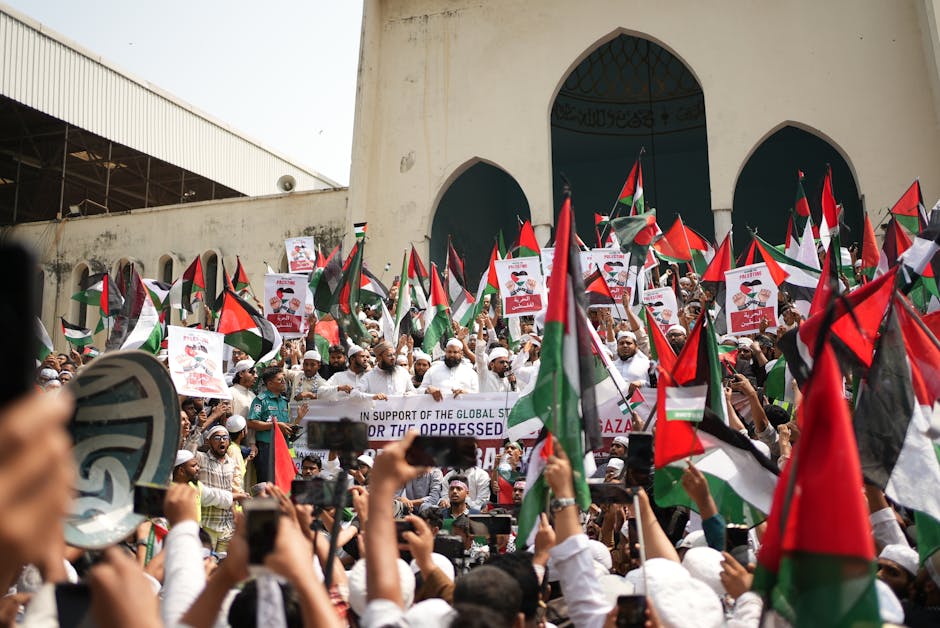
- CCTV footage captured an Israeli strike on Palestinians in Gaza City, sparking outrage and calls for an end to the violence.
- The conflict between Israel and Palestine is rooted in long-standing disputes over territory, resources, and national identity.
- External actors, including the United States, have played significant roles in the ongoing conflict.
- The use of surveillance footage is becoming crucial in documenting human rights abuses and holding perpetrators accountable.
- Concerns about further escalation and the impact on civilians highlight the urgency of finding a peaceful resolution.
The latest escalation in the Israeli-Palestinian conflict has resulted in the loss of life and widespread destruction, with CCTV footage capturing the moment an Israeli strike hit a group of Palestinians in Gaza City on Friday. The surveillance cameras, mounted on nearby buildings, show the exact moment the strike occurred, sending debris flying and causing chaos in the area. The footage has sparked outrage and condemnation from human rights groups and international leaders, who are calling for an immediate end to the violence. As the situation continues to deteriorate, concerns are growing about the potential for further escalation and the impact on civilians caught in the crossfire. The use of surveillance footage has become increasingly important in documenting human rights abuses and holding those responsible accountable.
Background to the Conflict

The Israeli-Palestinian conflict has been ongoing for decades, with periods of relative calm punctuated by outbreaks of violence. The current escalation is rooted in a complex set of factors, including disputes over territory, resources, and national identity. The situation has been further complicated by the involvement of external actors, including the United States, which has historically been a key player in the region. Despite numerous attempts at negotiation and diplomacy, a lasting resolution to the conflict has yet to be found, and the situation remains volatile. The international community has a critical role to play in promoting peace and stability in the region, and it is essential that all parties work together to find a solution that respects the rights and dignity of all individuals involved. The use of diplomatic channels and international law can help to reduce tensions and prevent further violence.
The Israeli Strike

According to eyewitnesses and video footage, the Israeli strike occurred in the early hours of Friday morning, targeting a group of Palestinians in Gaza City. The exact circumstances surrounding the strike are still unclear, but it is believed that Israeli forces were responding to rocket fire from Palestinian militants. The strike resulted in the loss of life and injury to several others, with many more displaced from their homes. The Israeli military has stated that it is investigating the incident, but human rights groups have raised concerns about the disproportionate use of force and the potential for civilian casualties. The incident has sparked widespread condemnation, with many calling for an immediate end to the violence and a return to diplomatic efforts to resolve the conflict. The international community must work together to ensure that all parties respect international law and protect the rights of civilians.
Analysis of the Situation
The latest escalation in the Israeli-Palestinian conflict has significant implications for the region and the international community. The use of military force has failed to provide a lasting solution to the conflict, and it is essential that all parties work towards a diplomatic resolution. The involvement of external actors, including the United States, can play a critical role in promoting peace and stability in the region. However, it is also important to recognize the agency and autonomy of the parties involved, and to support their efforts to find a solution that respects the rights and dignity of all individuals. The situation is further complicated by the complex historical and cultural context of the conflict, which must be taken into account in any efforts to resolve it. Experts point to the need for a comprehensive and inclusive approach, one that addresses the underlying causes of the conflict and promotes a lasting and just peace. This can be achieved through the establishment of a negotiated settlement, based on international law and respect for human rights.
Implications of the Conflict
The Israeli-Palestinian conflict has far-reaching implications for the region and the international community. The ongoing violence and instability have resulted in significant humanitarian needs, with many civilians caught in the crossfire. The conflict also has significant economic and social implications, with trade and commerce disrupted and many communities affected. The international community has a critical role to play in promoting peace and stability in the region, and it is essential that all parties work together to find a solution that respects the rights and dignity of all individuals involved. The use of diplomatic channels and international law can help to reduce tensions and prevent further violence, promoting a lasting and just peace. It is also important to recognize the impact of the conflict on civilians, including women and children, and to take steps to protect their rights and provide humanitarian assistance as needed.
Expert Perspectives
Experts on the region are divided on the best way to resolve the conflict, with some calling for a return to negotiations and others advocating for a more robust international response. Some argue that the Israeli government’s actions are disproportionate and that a more nuanced approach is needed, one that takes into account the complex historical and cultural context of the conflict. Others point to the need for Palestinian militants to cease rocket fire and to work towards a diplomatic solution. Despite these differences, there is a broad consensus on the need for a lasting and just peace, one that respects the rights and dignity of all individuals involved. It is essential that all parties work together to find a solution that promotes peace and stability in the region, and that the international community supports these efforts through diplomatic channels and international law.
As the situation continues to unfold, it is essential to watch for further developments and to consider the potential implications of different courses of action. The international community must work together to promote peace and stability in the region, and to support the efforts of all parties to find a lasting and just solution to the conflict. This can be achieved through the establishment of a negotiated settlement, based on international law and respect for human rights. The use of diplomatic channels and international law can help to reduce tensions and prevent further violence, promoting a lasting and just peace. It is also important to recognize the impact of the conflict on civilians and to take steps to protect their rights and provide humanitarian assistance as needed. One open question is how the international community will respond to the ongoing violence and instability, and what steps will be taken to promote a lasting and just peace in the region.