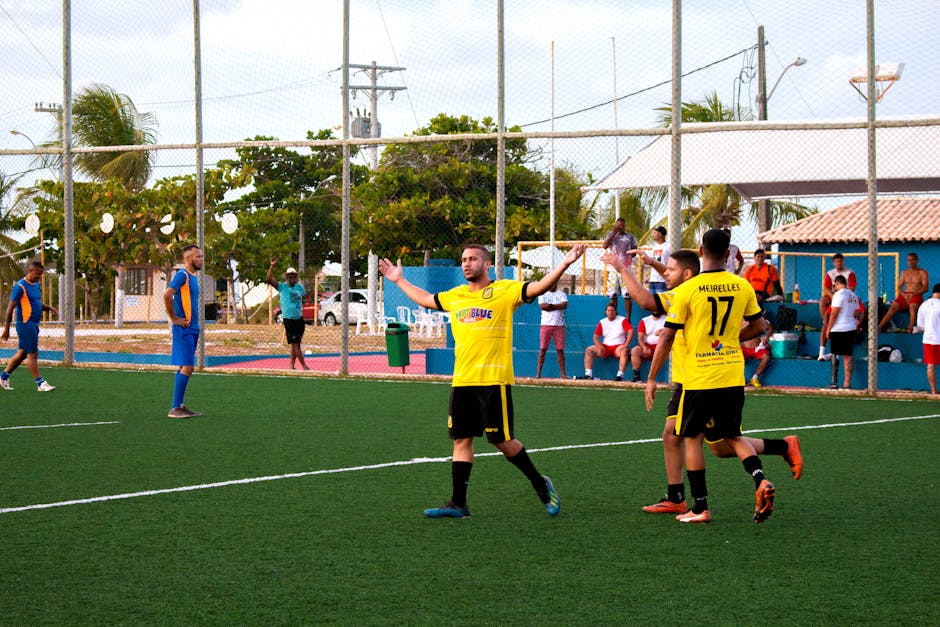
- The World Cup 2026 will introduce new regulations to tackle on-field protests, aiming to reduce controversy and maintain discipline.
- Players may receive straight red cards for covering their mouths when confronting opponents or protesting refereeing decisions.
- The International Football Association Board (Ifab) has approved the new regulation to address recent controversies.
- The new protocols will be in effect for the World Cup 2026, starting in June.
- Players, coaches, and officials will need to adjust to the new rules to avoid severe penalties.
The upcoming World Cup 2026 is set to witness a significant change in the way players express their dissent on the field. In a bid to maintain discipline and reduce controversy, the International Football Association Board (Ifab) has approved a new regulation that could see players receiving straight red cards for covering their mouths when confronting an opponent or leaving the pitch in protest at a refereeing decision. This move is expected to have a profound impact on the game, as players will need to be more mindful of their actions and reactions to avoid severe penalties.
Background and Context

The introduction of this new regulation is not without precedent. Recent controversies, including the Prestianni incident and the Afcon final, have highlighted the need for stricter measures to be put in place. The Ifab has been working to address these issues, and the new protocols are a direct result of these efforts. With the World Cup 2026 just around the corner, the timing of this announcement is crucial, as it will give players, coaches, and officials ample time to adjust to the new rules and understand the implications of non-compliance.
The New Regulations

The new regulation change, approved by the Ifab ahead of the Fifa Congress in Vancouver, will be in effect for the World Cup 2026, which begins in June. According to the new protocols, any player who covers their mouth when confronting an opponent or leaves the pitch in protest at a refereeing decision will be liable to receive a straight red card. This decision is expected to have far-reaching consequences, as it will not only impact the players but also the teams and the overall dynamics of the game. The Ifab has, however, clarified that this change will not be mandated for other competitions, at least not for the time being.
Analysis and Implications
The introduction of these new regulations is likely to have a significant impact on the game. On one hand, it will help to reduce on-field protests and promote a more respectful atmosphere. On the other hand, it may also lead to controversy and debate, particularly if players feel that the rules are being applied too harshly or inconsistently. The key to the success of these new protocols will lie in their implementation and the consistency with which they are applied. Ifab will need to work closely with referees, coaches, and players to ensure that everyone is on the same page and that the rules are enforced fairly and uniformly.
Implications for the Game
The new regulations will have significant implications for the players, teams, and the game as a whole. Players will need to be more mindful of their actions and reactions, as a single mistake could result in a red card and potentially change the course of the game. Teams will need to adapt their strategies and ensure that their players are aware of the new rules and the consequences of non-compliance. The game itself will also be impacted, as the reduced protests and increased discipline will likely lead to a more respectful and enjoyable atmosphere for spectators.
Expert Perspectives
Experts and analysts have weighed in on the new regulations, offering contrasting viewpoints on the potential impact. Some believe that the new rules will help to improve the game and reduce controversy, while others argue that they may be too harsh and could lead to unfair penalties. As one expert noted, “The key to the success of these new protocols will be consistency and fairness. If the rules are applied uniformly and without bias, they could have a positive impact on the game. However, if they are applied inconsistently or harshly, they could lead to controversy and debate.”
As the World Cup 2026 approaches, all eyes will be on the implementation of these new regulations. Will they have the desired impact, or will they lead to controversy and debate? Only time will tell, but one thing is certain – the game will be watching with bated breath as the new protocols are put to the test. The question on everyone’s mind is: will the new regulations be enough to curb on-field protests and improve player behavior, or will they need to be revised or expanded upon in the future?