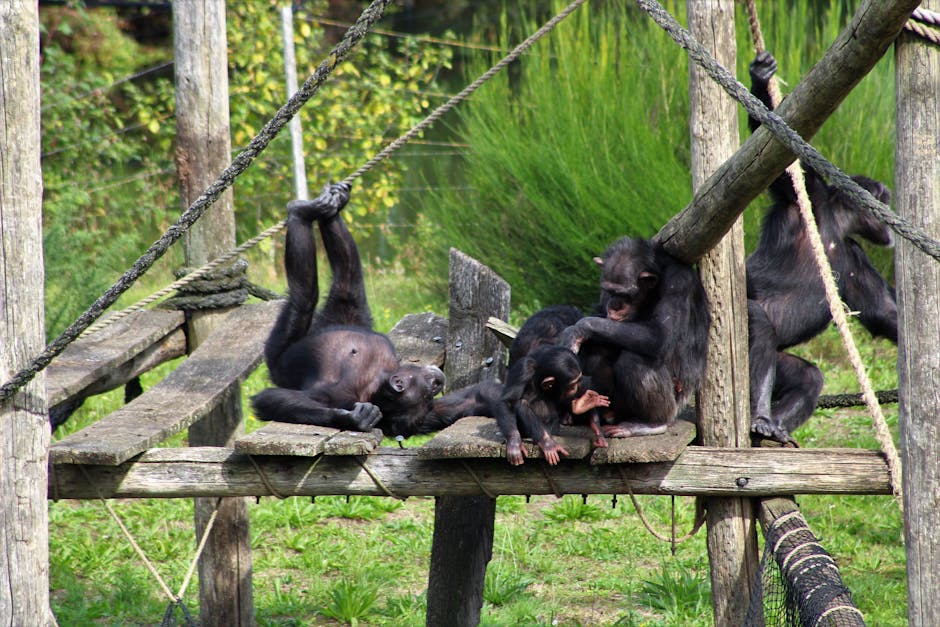
- Adult apes and monkeys living in despotic societies are less likely to engage in playful behavior.
- Juvenile primates are universally playful, but adults in authoritarian societies tend to lose this trait as they mature.
- Play is crucial for juvenile primate development, allowing them to develop social and motor skills.
- Egalitarian primate societies, where power is evenly distributed, tend to have more adult playfulness.
- Despotic societies, with dominant individuals, tend to suppress adult playfulness in primates.
A striking fact has emerged from the world of primate research: adult apes and monkeys that live in despotic societies are significantly less likely to engage in playful behavior. This finding, published in a recent study in Nature, has shed new light on the complex relationship between social hierarchy and playfulness in our closest living relatives. The study’s authors observed that, while juvenile primates are universally playful, adults in more authoritarian societies tend to lose this trait as they mature. This raises important questions about the role of play in primate social development and the factors that influence its expression in different social contexts.
The Evolution of Playfulness

The discovery that despotic primate societies may suppress adult playfulness is particularly noteworthy given the importance of play in primate development. Play is a crucial component of juvenile primate behavior, allowing young animals to develop essential social and motor skills. As primates mature, however, their playfulness often gives way to more serious adult responsibilities. But why do some adult primates retain their playful nature, while others do not? The answer, it seems, may lie in the social structure of their communities. In more egalitarian societies, where power is distributed relatively evenly among group members, adult playfulness is more common. In contrast, despotic societies, where a single dominant individual wields significant power and control, playfulness is often suppressed.
Key Findings

The study’s authors analyzed data from a range of primate species, including chimpanzees, bonobos, and macaques. They found that, in despotic societies, adult primates were less likely to engage in playful activities such as chasing, tickling, and wrestling. This was true even when controlling for factors such as age, sex, and social status. The researchers also observed that, in more egalitarian societies, adult primates were more likely to initiate play and to play with multiple partners. These findings suggest that the social context in which primates live has a profound impact on their behavior and that playfulness is an important aspect of primate sociality.
Causes and Consequences
So why do despotic societies suppress adult playfulness? One possible explanation is that, in these societies, play is seen as a threat to the dominant individual’s power and control. By suppressing play, dominant individuals may be able to maintain their position and prevent challenges to their authority. Alternatively, the suppression of play may be a consequence of the stress and anxiety that can accompany life in a despotic society. Chronic stress has been shown to have a range of negative effects on primate behavior and physiology, including suppressing playfulness. Whatever the cause, the consequences of suppressed playfulness are likely to be significant, affecting not only the individual primates involved but also the social dynamics of the group as a whole.
Implications
The study’s findings have important implications for our understanding of primate social behavior and the evolution of playfulness. They suggest that play is not just a frivolous activity, but a crucial component of primate social development and a key aspect of primate sociality. The suppression of playfulness in despotic societies may have significant consequences for the welfare and well-being of individual primates, as well as for the long-term stability and cohesion of the group. As we continue to learn more about the complex social lives of primates, we are reminded of the importance of considering the social context in which behavior evolves and the need to protect and preserve the natural habitats of these fascinating creatures.
Expert Perspectives
Experts in the field of primate research have welcomed the study’s findings, highlighting the importance of considering the social context in which behavior evolves. “This study demonstrates the complex interplay between social structure and behavior in primates,” said one researcher. “It highlights the need for further research into the causes and consequences of suppressed playfulness in despotic societies.” Others have noted the implications of the study’s findings for our understanding of human social behavior, pointing out that similar dynamics may be at play in human societies.
As we look to the future, it will be important to continue studying the complex social lives of primates and the factors that influence their behavior. What role does playfulness play in primate social development, and how can we work to protect and preserve this important aspect of primate sociality? These are questions that will require further research and consideration, but one thing is clear: the study of primate playfulness has the potential to reveal important insights into the evolution of social behavior and the complex dynamics of primate societies.