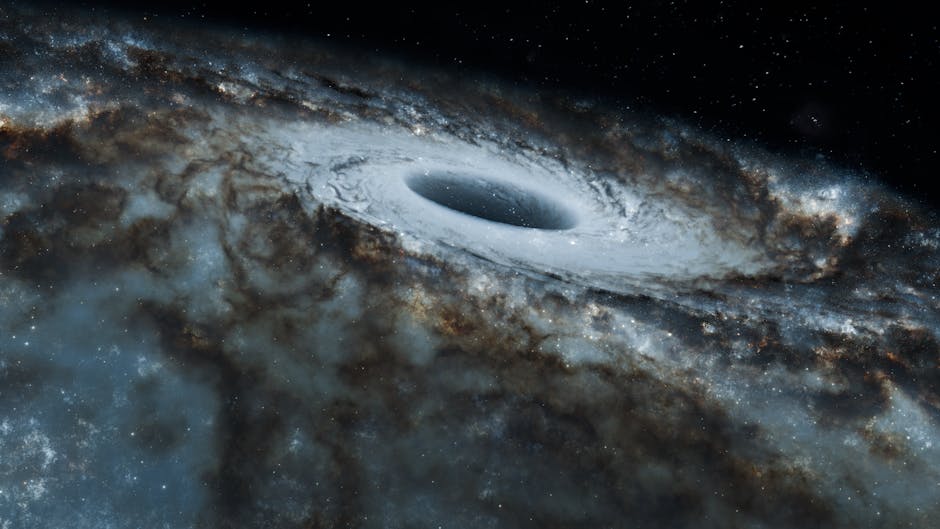
- A new study suggests that gravitational waves from the Big Bang could have spawned dark matter, a mysterious substance making up 27% of the universe’s mass-energy content.
- Gravitational waves are distortions in spacetime caused by violent cosmic events, such as black hole collisions or supernovae explosions.
- The study proposes that primordial gravitational waves might have had a profound impact on dark matter formation in the early universe.
- The origin of dark matter remains a major mystery in modern astrophysics, and this study offers a new hypothesis to explain its creation.
- The research, published in the Journal of Cosmology and Astroparticle Physics, could reshape our understanding of the early universe’s evolution.
In the chaotic first moments after the Big Bang, the universe was a seething cauldron of energy and matter. Among the many phenomena that unfolded, ripples in spacetime known as gravitational waves were thought to have played a significant role. Now, a groundbreaking new study suggests that these waves may have done more than just echo through the cosmos—they could have helped create dark matter, the mysterious and invisible substance that makes up about 27% of the universe’s mass-energy content.
The Origins of Gravitational Waves

Gravitational waves are distortions in the fabric of spacetime caused by some of the most violent and energetic processes in the universe, such as the collision of black holes or the explosion of supernovae. However, the initial burst of gravitational waves is believed to have originated from the Big Bang itself, a cosmic event that set the stage for the universe’s subsequent evolution. Recent research, published in the Journal of Cosmology and Astroparticle Physics, proposes that these primordial gravitational waves might have had a profound impact on the formation of dark matter, a hypothesis that could reshape our understanding of the early universe.
The Transformation Hypothesis

The study, led by a team of physicists from the University of Chicago and the Fermi National Accelerator Laboratory, explores the idea that gravitational waves in the early universe could have transformed into dark matter particles. This transformation would have occurred through a process known as gravitational particle production, where the intense energy of the waves could have been converted into particles that later coalesced into dark matter. The team’s simulations show that under certain conditions, this process could have produced enough dark matter to match the observed density in the universe today.
Implications for Cosmology
The hypothesis that gravitational waves could have created dark matter has far-reaching implications for cosmology. If proven true, it would provide a new mechanism for the formation of dark matter, complementing or even supplanting existing theories such as the production of dark matter through the decay of heavy particles. This could also shed light on the nature of dark matter itself, which remains one of the most significant puzzles in modern physics. Understanding how dark matter was formed could help scientists better predict its behavior and distribution, potentially leading to new breakthroughs in the field.
Expert Perspectives
While the hypothesis is intriguing, it remains a subject of debate among physicists. Dr. Maria Rodriguez, a cosmologist at the European Organization for Nuclear Research (CERN), notes, “This theory is a fascinating addition to our understanding of the early universe, but it requires further empirical evidence to be fully validated.” On the other hand, Dr. James Harper, a physicist from the University of Cambridge, is more optimistic: “The simulations are robust, and the idea aligns with several other theoretical models. It’s definitely worth investigating further.”
As the scientific community continues to explore this hypothesis, the quest to understand the origins of dark matter remains a critical area of research. The implications of this theory could not only refine our models of the universe’s early moments but also open new avenues for detecting and studying dark matter, a substance that continues to elude direct observation.