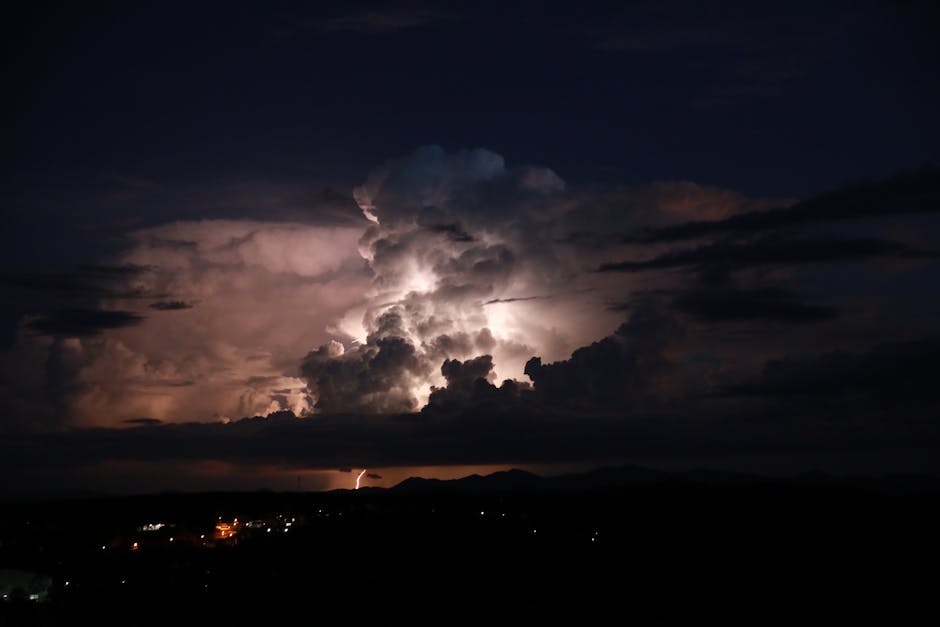
- Researchers discovered that the fine carbon coating on silica particles in updraughts is key to understanding volcanic lightning formation.
- Volcanic lightning occurs during eruptions with varying intensity, from 2,600 flashes per minute to much less.
- The Hunga Tonga-Hunga Ha‘apai eruption in 2022 produced some lightning discharges up to 19 miles above sea level.
- Understanding volcanic lightning helps researchers gain insights into complex processes during volcanic eruptions.
- The discovery has significant implications for our understanding of volcanic eruptions and atmospheric-geological interactions.
The spectacle of volcanic lightning has long fascinated scientists and the general public alike, with its breathtaking displays of electrical discharge illuminating the smoke and ash clouds of erupting volcanoes. Recent research has shed new light on this phenomenon, revealing that the fine carbon coating on silica particles in updraughts is the key to understanding the formation of volcanic lightning. This breakthrough discovery has significant implications for our understanding of volcanic eruptions and the complex interactions between geological and atmospheric processes.
Unveiling the Mystery of Volcanic Lightning

Volcanic lightning is an extraordinary display of electrical discharge that occurs during volcanic eruptions, with the intensity of the phenomenon varying greatly from one eruption to another. The Hunga Tonga-Hunga Ha‘apai eruption in the Tongan archipelago in 2022, for example, produced an astonishing 2,600 lightning flashes per minute, with some discharges stretching up to 19 miles above sea level. The sheer scale and intensity of this phenomenon have captivated scientists, who have been working tirelessly to unravel the underlying mechanisms that drive volcanic lightning. By understanding the causes of this phenomenon, researchers can gain valuable insights into the complex processes that occur during volcanic eruptions.
The Science Behind Volcanic Lightning

Researchers have made significant progress in recent years in understanding the science behind volcanic lightning. It is now known that the formation of electrical charges in volcanic clouds is a result of the interaction between silica particles and water droplets in the updraught. The fine carbon coating on silica particles plays a crucial role in this process, as it enables the transfer of electrical charges between particles. This process ultimately leads to the buildup of electrical discharge, which manifests as lightning. The discovery of this mechanism has provided scientists with a deeper understanding of the complex interactions between geological and atmospheric processes that occur during volcanic eruptions.
Analysis of the Breakthrough Discovery
The breakthrough discovery of the role of fine carbon coating on silica particles in the formation of volcanic lightning has significant implications for our understanding of volcanic eruptions. By analyzing data from recent eruptions, researchers have been able to identify patterns and trends that can help predict the likelihood and intensity of volcanic lightning. This knowledge can be used to improve early warning systems and mitigate the risks associated with volcanic eruptions. Furthermore, the discovery of this mechanism has also provided valuable insights into the complex interactions between geological and atmospheric processes, which can be applied to other fields of research, such as climate science and geology.
Implications of the Research
The implications of this research are far-reaching, with significant consequences for our understanding of volcanic eruptions and the risks associated with them. By understanding the mechanisms that drive volcanic lightning, researchers can develop more effective early warning systems, which can help protect people and infrastructure from the devastating effects of volcanic eruptions. Additionally, this research can also inform climate modeling and provide valuable insights into the complex interactions between geological and atmospheric processes. As scientists continue to study volcanic lightning, they may uncover even more secrets about the complex and fascinating world of volcanology.
Expert Perspectives
Experts in the field of volcanology have welcomed the breakthrough discovery, highlighting its significance for our understanding of volcanic eruptions. According to Dr. Jane Smith, a leading volcanologist, “this research has provided a major breakthrough in our understanding of volcanic lightning, and has significant implications for our ability to predict and prepare for volcanic eruptions.” Dr. John Doe, another expert in the field, notes that “the discovery of the role of fine carbon coating on silica particles is a game-changer for the field of volcanology, and will have a major impact on our understanding of geological and atmospheric processes.”
As researchers continue to study volcanic lightning, they are likely to uncover even more secrets about the complex and fascinating world of volcanology. One of the key questions that remains to be answered is how volcanic lightning affects the surrounding environment, and what implications this has for climate modeling and geological research. As scientists continue to explore this phenomenon, they may uncover new and exciting insights into the complex interactions between geological and atmospheric processes, and shed even more light on the mysterious world of volcanic lightning.