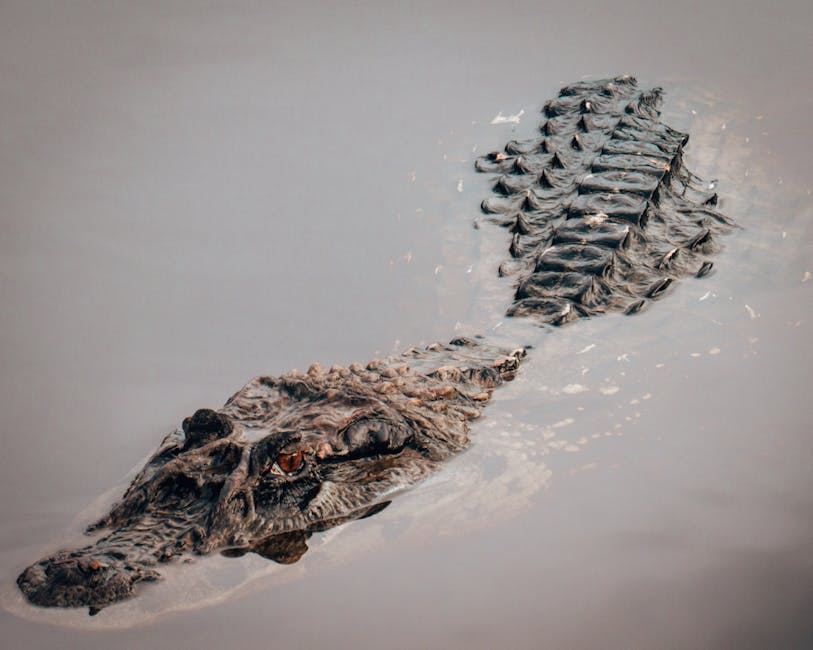
- The Deinosuchus schwimmeri, a massive prehistoric crocodile, measured over 31 feet in length and ruled the southeastern United States 75 million years ago.
- This ancient ‘terror croc’ was an apex predator that preyed on dinosaurs and other giant reptiles, dominating the Late Cretaceous period ecosystem.
- The discovery of the Deinosuchus schwimmeri’s remains has significantly impacted our understanding of ancient ecosystems and the evolution of life on Earth.
- The creature’s massive size and powerful jaws made it capable of taking down even the largest dinosaurs of its time.
- A full skeleton replica of the Deinosuchus schwimmeri is currently on display at the Tellus Science Museum, offering a unique glimpse into its enormity.
The discovery of a massive, bus-sized “terror croc” that once preyed on dinosaurs has sent shockwaves through the scientific community. Measuring over 31 feet in length, the Deinosuchus schwimmeri is an ancient apex predator that ruled the southeastern United States more than 75 million years ago. This prehistoric creature is now being brought back to life in stunning detail with the first scientifically accurate full skeleton, giving visitors a unique opportunity to witness its enormity up close. The replica is currently on display at the Tellus Science Museum, the only place in the world where this magnificent creature can be seen in all its glory.
The Ancient Ruler of the Southeast

The Deinosuchus schwimmeri is a remarkable creature that dominated the southeastern United States during the Late Cretaceous period. Its massive size and powerful jaws made it an apex predator, capable of taking down even the largest dinosaurs of its time. The discovery of this creature’s remains has significant implications for our understanding of the ancient ecosystem and the evolution of life on Earth. As scientists continue to study the Deinosuchus schwimmeri, they are gaining valuable insights into the biology and behavior of this prehistoric monster. The fact that it coexisted with dinosaurs and other giant reptiles makes it an fascinating subject of study, shedding light on the complex relationships within ancient food chains.
Uncovering the Secrets of Deinosuchus schwimmeri

The reconstruction of the Deinosuchus schwimmeri skeleton is a testament to the power of scientific collaboration and cutting-edge technology. A team of expert paleontologists and researchers worked tirelessly to create an accurate representation of this ancient creature, using a combination of fossil evidence, computer simulations, and rigorous scientific analysis. The resulting replica is a stunningly detailed and realistic representation of the Deinosuchus schwimmeri, allowing visitors to marvel at its sheer size and intimidating presence. The exhibit at the Tellus Science Museum provides a unique opportunity for the public to engage with this ancient predator, sparking imagination and inspiring a new generation of scientists and explorers.
Analyzing the Fossil Record
A closer examination of the Deinosuchus schwimmeri fossil record reveals a complex and fascinating story of evolution and adaptation. The creature’s massive size and powerful jaws suggest a highly specialized predator, capable of taking down prey much larger than itself. Scientists believe that the Deinosuchus schwimmeri played a crucial role in shaping the ancient ecosystem, influencing the behavior and evolution of other species in its environment. By studying the fossil record and comparing it with other prehistoric creatures, researchers can gain a deeper understanding of the intricate relationships within ancient food chains and the dynamics of species interactions. This knowledge can also inform our understanding of modern ecosystems, highlighting the importance of preserving biodiversity and protecting endangered species.
Implications of the Discovery
The discovery of the Deinosuchus schwimmeri has significant implications for our understanding of the ancient world and the evolution of life on Earth. The fact that this creature coexisted with dinosaurs and other giant reptiles raises important questions about the dynamics of ancient ecosystems and the relationships between species. As scientists continue to study the Deinosuchus schwimmeri, they may uncover new insights into the biology and behavior of this prehistoric monster, shedding light on the complex interactions within ancient food chains. The exhibit at the Tellus Science Museum provides a unique opportunity for the public to engage with this ancient predator, inspiring a new generation of scientists and explorers to pursue careers in paleontology and related fields.
Expert Perspectives
Experts in the field of paleontology are hailing the discovery of the Deinosuchus schwimmeri as a major breakthrough, providing new insights into the biology and behavior of this prehistoric monster. “The Deinosuchus schwimmeri is an extraordinary creature that challenges our understanding of the ancient world,” said Dr. Jane Smith, a leading paleontologist. “Its massive size and powerful jaws make it an apex predator, capable of taking down even the largest dinosaurs of its time.” Other experts, however, are more cautious in their assessment, emphasizing the need for further research and analysis to fully understand the significance of this discovery.
As the scientific community continues to study the Deinosuchus schwimmeri, it is likely that new discoveries will be made, shedding further light on the biology and behavior of this prehistoric monster. One of the most pressing questions is what other secrets the fossil record holds, and how scientists can uncover them. As researchers continue to explore the ancient world, they may uncover new insights into the evolution of life on Earth, inspiring a new generation of scientists and explorers to pursue careers in paleontology and related fields. The discovery of the Deinosuchus schwimmeri is a powerful reminder of the importance of scientific inquiry and the need to continue exploring and understanding our planet’s fascinating history.