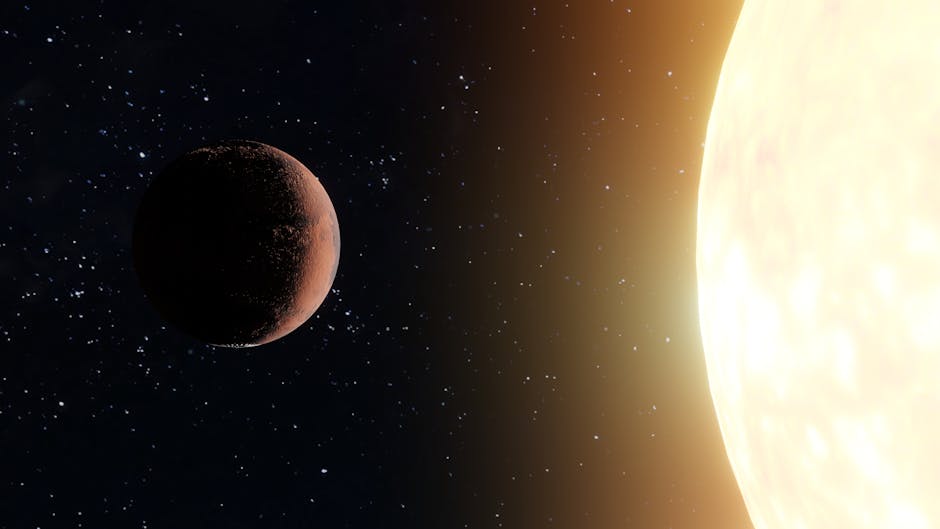
- Binary star systems are estimated to make up 50% of all star systems, yet planets that orbit two stars are surprisingly rare.
- Scientists have been puzzled by the lack of two-sun planets, with some suggesting the possibility of a cosmic explanation.
- Recent research suggests that Albert Einstein’s theory of general relativity may be the culprit behind the rarity of two-sun planets.
- The discovery of exoplanets has revealed thousands of planets, but only a few are known to orbit two stars.
- The rarity of two-sun planets may be due to the intense gravitational forces and tidal interactions in binary star systems.
The universe is full of mysteries, but one phenomenon has long puzzled astronomers: the surprising rarity of planets orbiting two stars, like the fictional planet of Tatooine from the Star Wars franchise. Despite the fact that binary star systems are common, with some estimates suggesting that up to 50% of all star systems are binary, planets that orbit two stars are few and far between. This has led scientists to wonder what could be causing this cosmic discrepancy, with some even suggesting that it could be due to the very fabric of space and time itself. Recent research has shed new light on this mystery, and the culprit may be none other than Albert Einstein’s groundbreaking theory of general relativity.
The Rarity of Two-Sun Planets

The discovery of exoplanets, which are planets that orbit stars outside of our own solar system, has been a booming field of research in recent years. With the help of advanced telescopes and detection methods, scientists have discovered thousands of exoplanets, ranging in size from small, rocky worlds to massive gas giants. However, despite the large number of exoplanets that have been discovered, very few of them orbit two stars. This is surprising, as binary star systems are common, and one would expect to see a corresponding number of planets that orbit two stars. The fact that this is not the case has led scientists to wonder what could be causing the rarity of two-sun planets, and whether it could be due to some fundamental aspect of the universe.
General Relativity and Orbital Instability

New research suggests that the culprit behind the rarity of two-sun planets may be none other than Einstein’s theory of general relativity. According to this theory, the curvature of space and time caused by massive objects such as stars can have a profound impact on the orbits of planets. In the case of binary star systems, the gravitational interaction between the two stars can cause the orbit of a planet to become unstable, leading to its ejection from the system or even its collision with one of the stars. This effect is particularly pronounced in systems where the two stars are close together, as the gravitational interaction between them is stronger. As a result, planets that form in these systems may be quickly ejected, explaining why they are so rare.
Implications for Planet Formation
The discovery that general relativity may be responsible for the rarity of two-sun planets has significant implications for our understanding of planet formation. If the gravitational interaction between two stars can cause the orbit of a planet to become unstable, it could limit the types of systems in which planets can form. This, in turn, could have a profound impact on the search for life beyond our solar system, as binary star systems are often considered to be prime targets in the search for extraterrestrial life. The fact that these systems may be less hospitable to planet formation than previously thought could force scientists to rethink their strategy for searching for life beyond Earth.
Consequences for the Search for Life
The rarity of two-sun planets may have significant consequences for the search for life beyond our solar system. If binary star systems are less hospitable to planet formation than previously thought, it could limit the number of potential targets in the search for extraterrestrial life. This, in turn, could make the search for life more challenging, as scientists may need to focus on systems that are less common or more difficult to detect. On the other hand, the fact that general relativity may be responsible for the rarity of two-sun planets could also provide a new avenue for research, as scientists seek to understand the complex interactions between stars and planets in binary systems.
Expert Perspectives
Scientists are divided on the implications of the new research, with some hailing it as a major breakthrough and others expressing caution. “The discovery that general relativity may be responsible for the rarity of two-sun planets is a game-changer for our understanding of planet formation,” said one expert. “It highlights the complex and often unexpected ways in which the universe works, and underscores the need for continued research into the fundamental laws of physics.” Others, however, are more skeptical, pointing out that the research is still in its early stages and that more work is needed to fully understand the implications of the findings.
As scientists continue to study the phenomenon of two-sun planets, they will be watching closely to see how the new research holds up to scrutiny. One key question that remains to be answered is whether the effect of general relativity on planetary orbits is unique to binary star systems, or whether it could also play a role in other types of systems. If the latter is the case, it could have significant implications for our understanding of planet formation and the search for life beyond our solar system. As one expert noted, “The study of two-sun planets is a fascinating area of research that continues to yield new and unexpected insights into the workings of the universe. As we continue to explore this phenomenon, we may uncover even more surprises that challenge our current understanding of the cosmos.”