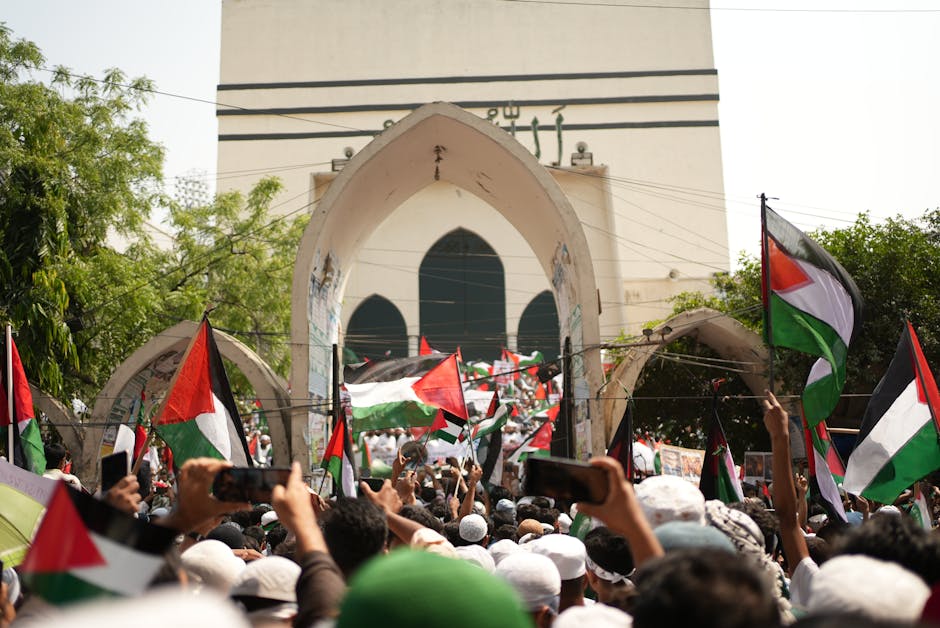
- Britain’s far-right groups have adopted Saint George as a symbol of bravery and martyrdom to further their agendas.
- The celebration of Saint George highlights the complex and often contradictory nature of far-right movements, which appropriate historical and religious symbols.
- The saint’s values of courage, honor, and sacrifice are appealed to by far-right groups to justify their stance on immigration and national sovereignty.
- The timing of these celebrations coincides with broader debates in British society about national identity and cultural heritage.
- Far-right groups in Britain are using the symbolism of Saint George to assert their legitimacy and connect with a sense of national pride.
The streets of Manchester recently witnessed a striking display of far-right nationalism as hundreds of Britain First supporters marched to celebrate Saint George, a figure revered not only in England but also in Palestine. This convergence of ideologies may seem unexpected, given the geographical and cultural distances between these two contexts. However, it underscores the complex and often contradictory nature of far-right movements, which frequently appropriate historical and religious symbols to further their agendas. The use of Saint George, a saint known for his bravery and martyrdom, as a rallying point for far-right groups in Britain, speaks to deeper issues of identity, nationalism, and the quest for legitimacy among these movements.
Historical Significance and Contemporary Relevance

The celebration of Saint George by Britain’s far-right comes at a time when questions of national identity and cultural heritage are highly contested. Saint George, recognized as the patron saint of England, among other countries, embodies values of courage, honor, and sacrifice, which are appealed to by far-right groups to justify their stance on immigration, multiculturalism, and national sovereignty. The timing of these celebrations is not coincidental, as they coincide with broader debates in British society about its place in the world, the impact of globalization, and the challenges posed by diverse communities. By claiming Saint George as their symbol, far-right supporters aim to tap into a deep sense of historical and cultural continuity, thereby legitimizing their political demands and ideologies.
The March in Manchester: A Display of Far-Right Unity

The march in Manchester, organized by Britain First, a group known for its anti-immigrant and anti-Islamic stance, brought together hundreds of supporters who waved flags, banners, and posters bearing the image of Saint George. The event was marked by speeches that emphasized the need to protect English culture and traditions, which, according to the speakers, are under threat from immigration and multicultural policies. The choice of Saint George as the focal point of this rally was significant, as it allowed the organizers to frame their political agenda within a narrative of historical and religious legitimacy. However, the event was not without controversy, as counter-protesters and local community groups criticized the march for promoting hatred and division, highlighting the tense and often confrontational nature of far-right activism in Britain.
Analysis: The Appropriation of Religious Symbols
The appropriation of Saint George by Britain’s far-right reflects a broader trend within extremist movements to co-opt religious and historical symbols for political purposes. This phenomenon is not unique to Britain, as similar movements across Europe and beyond have sought to reclaim or redefine national identities through the lens of religion and history. The use of Saint George, in particular, highlights the selective nature of this appropriation, where elements of history and religion that are deemed useful for promoting a particular political agenda are emphasized, while others are ignored or distorted. Experts point out that such appropriations not only distort the original meanings and significance of these symbols but also contribute to a polarized political environment, where dialogue and compromise become increasingly difficult.
Implications: Identity, Community, and the Future of Nationalism
The celebration of Saint George by Britain’s far-right has significant implications for how we understand identity, community, and the future of nationalism in Britain. By appropriating a religious figure revered in multiple cultural contexts, far-right groups aim to redefine what it means to be English, excluding those who do not fit their narrow definition of national identity. This development raises important questions about the inclusivity of British society, the role of religion in public life, and the challenges of managing diversity in a globalized world. As Britain navigates its relationships with Europe and the rest of the world, the embrace of Saint George by far-right groups serves as a reminder of the deep-seated tensions and contradictions within British society, which will need to be addressed through open dialogue and a commitment to inclusivity and respect for diversity.
Expert Perspectives
Experts on extremism and nationalism offer contrasting viewpoints on the significance of Saint George’s celebration by Britain’s far-right. Some view this development as a dangerous sign of escalating radicalization, where religious symbols are used to justify xenophobic and racist ideologies. Others argue that it reflects a deeper crisis of identity and belonging within British society, which far-right groups exploit to further their political agendas. Regardless of perspective, there is a consensus that the appropriation of religious symbols for political purposes contributes to social division and undermines efforts to build a more inclusive and tolerant society.
Looking forward, the key question is how British society will respond to the challenges posed by far-right nationalism and the appropriation of religious symbols for political ends. Will there be a concerted effort to reclaim and redefine national identity in a more inclusive and respectful manner, or will the polarization of British politics continue to escalate? The answer to this question will depend on the ability of political leaders, community groups, and individuals to engage in open and honest dialogue about the future of British society, recognizing the diversity of its population and the need to build bridges rather than barriers between different communities.