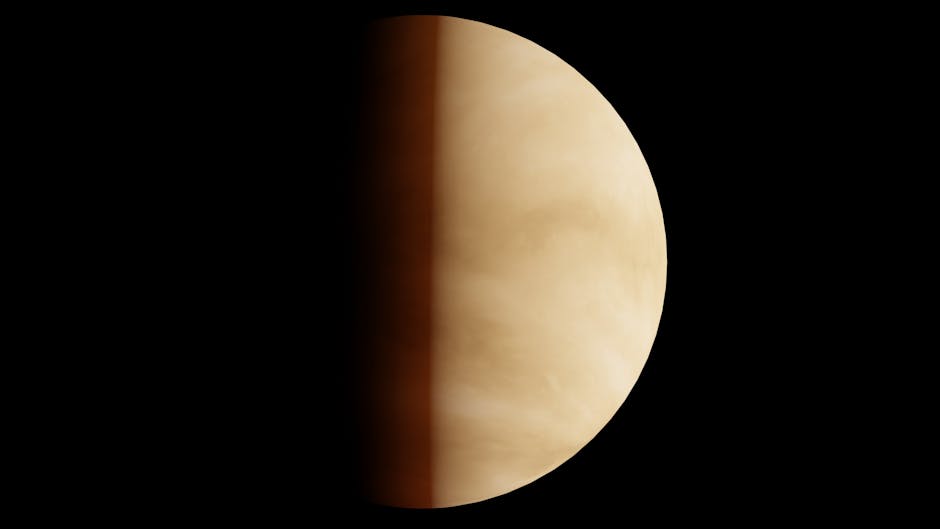
- Venus’s impenetrable haze is made up of cosmic dust, suggesting the planet’s atmosphere is influenced by outer space.
- Recent research reveals that the layer beneath Venus’s acidic clouds is comprised of cosmic dust.
- The study of Venus’s atmosphere is a complex challenge due to its extremely hostile environment.
- The planet’s surface temperature reaches as high as 462°C, making it the hottest planet in the solar system.
- Scientists have used computer modelling to simulate the behavior of particles in Venus’s atmosphere, providing a major breakthrough in understanding the planet’s atmosphere.
The planet Venus has long been a subject of fascination for astronomers and scientists, with its thick atmosphere and extreme greenhouse effect making it one of the most inhospitable places in the solar system. One of the most intriguing aspects of Venus’s atmosphere is its impenetrable haze, which has puzzled scientists for decades. Recent research, however, has shed new light on the composition of this haze, suggesting that it may be made up of particles from outer space. According to a study published in the journal Nature, modelling suggests that the layer beneath Venus’s acidic clouds is comprised of cosmic dust, which has significant implications for our understanding of the planet’s atmosphere and its potential for supporting life.
Unveiling the Mysteries of Venus’s Atmosphere

The study of Venus’s atmosphere is a complex and challenging task, due to its extremely hostile environment. The planet’s surface temperature reaches as high as 462°C, making it the hottest planet in the solar system, and its atmosphere is composed mostly of carbon dioxide, with thick clouds of sulfuric acid and droplets of sulfuric acid. Despite these challenges, scientists have been able to gather data on the planet’s atmosphere using a variety of techniques, including spacecraft and telescopic observations. The new research, which used computer modelling to simulate the behavior of particles in Venus’s atmosphere, provides a major breakthrough in our understanding of the planet’s haze and its potential origins.
Cosmic Dust and the Formation of Venus’s Haze

The idea that Venus’s haze could be made up of cosmic dust is not entirely new, but the latest research provides strong evidence to support this theory. According to the study, the particles that make up the haze are likely to be tiny, measuring only a few micrometers in diameter, and are thought to have originated from outer space. The researchers used computer simulations to model the behavior of these particles, taking into account factors such as their size, shape, and composition, as well as the conditions in Venus’s atmosphere. The results suggest that the particles are able to survive the harsh conditions in Venus’s atmosphere and accumulate in the layer beneath the acidic clouds, forming the impenetrable haze that has been observed.
Understanding the Implications of Cosmic Dust in Venus’s Atmosphere
The discovery that Venus’s haze is made up of cosmic dust has significant implications for our understanding of the planet’s atmosphere and its potential for supporting life. The presence of cosmic dust in the atmosphere could provide a source of nutrients and energy for microorganisms, which could potentially thrive in the layer beneath the acidic clouds. Additionally, the study of cosmic dust in Venus’s atmosphere could provide insights into the formation and evolution of the solar system, as well as the potential for life on other planets. The researchers note that further study is needed to fully understand the implications of their findings, but the discovery of cosmic dust in Venus’s atmosphere is a major step forward in our understanding of this enigmatic planet.
Implications for Future Research and Exploration
The discovery that Venus’s haze is made up of cosmic dust has significant implications for future research and exploration of the planet. The presence of cosmic dust in the atmosphere could provide a target for future spacecraft missions, which could be designed to study the particles in detail and gather more information about their composition and origins. Additionally, the study of cosmic dust in Venus’s atmosphere could provide insights into the potential for life on other planets, and could inform the search for life beyond Earth. The researchers note that further study is needed to fully understand the implications of their findings, but the discovery of cosmic dust in Venus’s atmosphere is a major step forward in our understanding of this enigmatic planet and its potential for supporting life.
Expert Perspectives
The discovery that Venus’s haze is made up of cosmic dust has been met with excitement and interest from the scientific community. According to Dr. Maria Rodriguez, a planetary scientist at NASA, the findings have significant implications for our understanding of Venus’s atmosphere and its potential for supporting life. ‘The discovery of cosmic dust in Venus’s atmosphere is a major breakthrough in our understanding of this enigmatic planet,’ she said. ‘It provides a new perspective on the potential for life on Venus and could inform the search for life beyond Earth.’
As researchers continue to study Venus’s atmosphere and the implications of cosmic dust, there are many questions that remain unanswered. What is the exact composition of the cosmic dust, and how does it interact with the planet’s atmosphere? How does the presence of cosmic dust affect the potential for life on Venus, and what are the implications for the search for life beyond Earth? These are just a few of the questions that will be addressed in future research, as scientists continue to explore the mysteries of Venus’s atmosphere and its potential for supporting life.