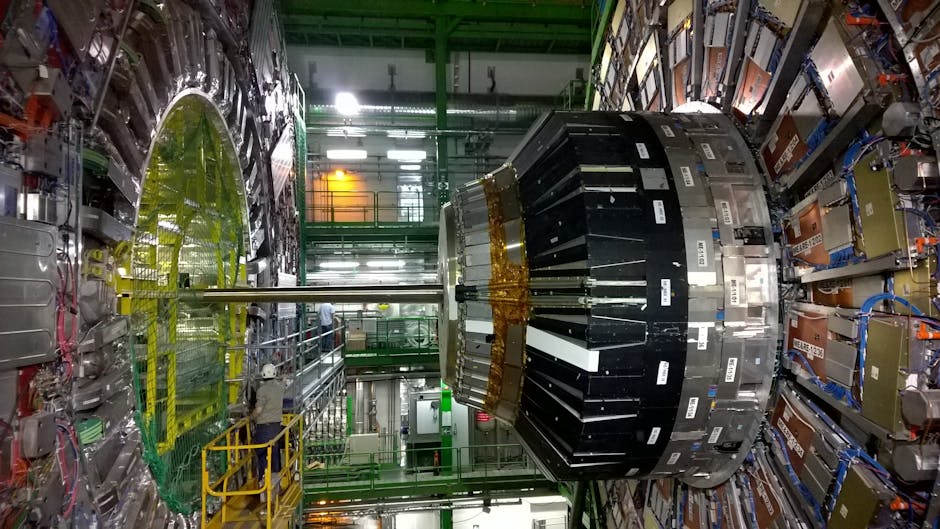
- The muon collider is emerging as a potential successor to the aging Large Hadron Collider (LHC).
- The muon collider promises unprecedented energy levels and precision, revolutionizing our understanding of the universe.
- The search for a new collider is driven by the limitations of current technology and the need for higher energy collisions.
- The muon collider has the potential to shed light on enduring mysteries, such as dark matter and dark energy.
- The muon collider’s innovative design could propel physics into a new era of discovery and exploration.
The concept of a muon collider, once deemed impossible by many physicists, is now gaining significant traction as a potential successor to the Large Hadron Collider (LHC). With the LHC nearing the end of its lifespan, the scientific community is eagerly searching for the next breakthrough technology that can unlock the secrets of the universe. The muon collider, with its promise of unprecedented energy levels and precision, is emerging as a top contender to take the reins from the LHC. This collider has the potential to revolutionize our understanding of the fundamental forces of nature and shed light on some of physics’ most enduring mysteries, including the nature of dark matter and dark energy.
The Quest for a New Collider

The search for a new collider is not merely a pursuit of novelty, but a necessity driven by the limitations of current technology. The LHC, which has been operational since 2008, has made groundbreaking discoveries, including the detection of the Higgs boson. However, its energy capabilities are limited, and physicists are now seeking a machine that can operate at even higher energies, allowing for more precise and in-depth exploration of the universe’s fundamental building blocks. The muon collider, with its innovative design and potential for higher energy collisions, is poised to meet this challenge and propel physics into a new era of discovery.
How the Muon Collider Works

The muon collider operates on a principle similar to that of the LHC, but with a crucial difference. Instead of using protons, it utilizes muons, which are heavier and more unstable particles. This difference allows the muon collider to achieve higher energy levels with less energy loss, making it potentially more powerful than the LHC. The process involves accelerating muons to nearly the speed of light and then colliding them, producing a plethora of subatomic particles that can be analyzed to understand the underlying forces and structures of the universe. The technical challenges in creating and maintaining a stable beam of muons are significant, but the potential payoff in terms of scientific discovery makes the endeavor worthwhile.
Analyzing the Potential Impact
The potential of the muon collider to transform our understanding of physics is vast. By operating at higher energies and with greater precision, it could reveal new particles and forces that are beyond the reach of current technology. This could include the discovery of new dimensions, the elucidation of the hierarchy problem, and insights into the unification of forces. Furthermore, the muon collider could provide a unique window into the universe’s earliest moments, allowing scientists to study the conditions under which the cosmos evolved. The data generated by the collider would be a treasure trove for physicists, offering a wealth of information to analyze and interpret, and potentially leading to a paradigm shift in our comprehension of reality.
Implications for the Scientific Community
The implications of a successful muon collider are far-reaching, affecting not just the field of physics but also interdisciplinary research and our broader understanding of the universe. The discoveries made possible by this technology could have profound effects on fields such as cosmology, particle physics, and materials science. Moreover, the technological innovations required to build and operate the muon collider could have spin-off benefits, leading to advancements in fields such as medicine, energy, and computing. The potential for breakthroughs in our understanding of dark matter and dark energy, which make up a large portion of the universe’s mass-energy budget but remain poorly understood, is particularly significant, as it could revolutionize cosmology and our understanding of the universe’s evolution.
Expert Perspectives
Physicists and experts in the field are eagerly anticipating the development of the muon collider, with some hailing it as the future of particle physics. While there are challenges to overcome, including the technical difficulties of working with muons and the significant investment required, the consensus is that the potential rewards are well worth the effort. Experts contrast the muon collider with other proposed next-generation colliders, highlighting its unique advantages and the breadth of scientific questions it could address. The variety of viewpoints reflects the complexity and the promising nature of this endeavor, with some emphasizing the need for international collaboration to bring this project to fruition.
As the scientific community looks to the future, the muon collider represents a compelling direction for research, with its potential to unlock new secrets of the universe and push the boundaries of human knowledge. The path ahead will be challenging, requiring significant advances in technology and substantial investment. However, the possibility of gaining a deeper understanding of the universe and the laws that govern it makes the pursuit of the muon collider an exciting and worthwhile endeavor. As physicists and engineers begin the process of designing and building this new collider, the world waits with bated breath, anticipating the discoveries that will emerge from this revolutionary technology and the new window it will open into the nature of reality.