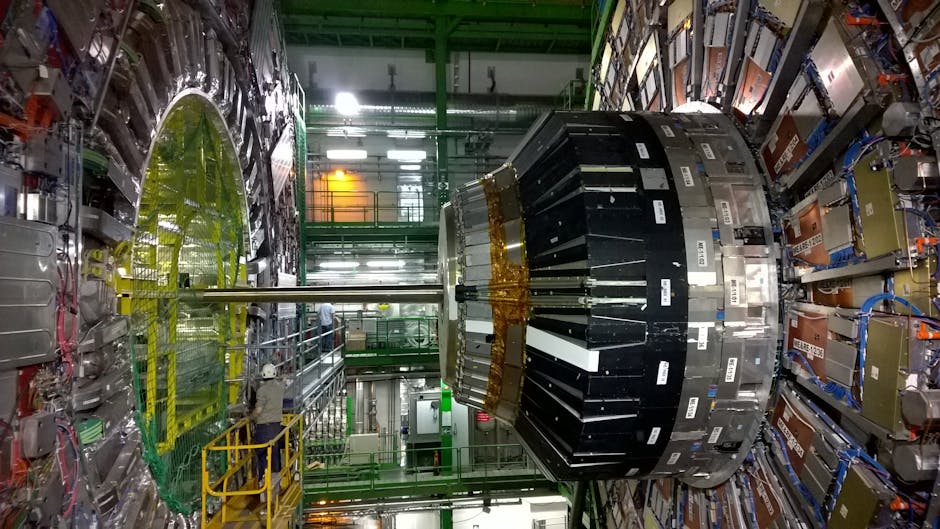
- Physicists have achieved unprecedented precision in calculating the strong coupling constant αs using lattice quantum chromodynamics simulations.
- The record precision of 0.2% in calculating αs enables more accurate predictions and tests of the Standard Model of particle physics.
- The strong coupling constant αs plays a crucial role in governing interactions between quarks and gluons in the Standard Model.
- Advances in computational power and algorithms have made it possible to reduce theoretical uncertainty in calculating αs.
- The precise calculation of αs paves the way for more precise tests of the Standard Model and searches for new physics.
The strong coupling constant αs, a fundamental parameter in particle physics, has been calculated with unprecedented precision using large-scale lattice quantum chromodynamics simulations. This breakthrough, published in the journal Nature, marks a significant milestone in the quest for a deeper understanding of the universe, with the calculated value of αs at a record precision of 0.2%. The achievement has far-reaching implications, enabling more accurate predictions and tests of the Standard Model of particle physics, which describes the behavior of fundamental particles and forces in the universe.
The Quest for Precision

The strong coupling constant αs plays a crucial role in the Standard Model, governing the interactions between quarks and gluons, the building blocks of protons and neutrons. For decades, scientists have been striving to determine αs with increasing precision, driven by the need to test the validity of the Standard Model and to search for signs of new physics beyond it. The latest calculation, made possible by advances in computational power and algorithms, represents a major step forward, reducing theoretical uncertainty and paving the way for more precise tests of the Standard Model.
Simulation and Calculation

The calculation of αs was performed using large-scale lattice quantum chromodynamics simulations, which involve discretizing spacetime into a grid and solving the equations of quantum chromodynamics on this grid. The simulations were run on powerful supercomputers, generating vast amounts of data that were then analyzed using sophisticated statistical methods. The result is a highly precise determination of αs, which has been verified through rigorous cross-checks and validation procedures. The calculation involved the collaboration of scientists from multiple institutions, highlighting the global nature of modern scientific research.
Implications and Analysis
The precise calculation of αs has significant implications for particle physics, enabling more accurate predictions and tests of the Standard Model. The reduced theoretical uncertainty will also impact the search for new physics beyond the Standard Model, such as supersymmetry and extra dimensions. Furthermore, the achievement demonstrates the power of lattice quantum chromodynamics simulations, which have become a crucial tool in the study of strong interactions. The calculation of αs is a testament to the ingenuity and perseverance of scientists, who have developed innovative methods and algorithms to tackle complex problems in particle physics.
Impact and Applications
The precise determination of αs will have a lasting impact on the field of particle physics, influencing the design of future experiments and the interpretation of data from current and upcoming experiments, such as the Large Hadron Collider. The reduced uncertainty will also enable more precise tests of the Standard Model, allowing scientists to search for signs of new physics with greater sensitivity. Moreover, the achievement will have implications for our understanding of the universe, from the behavior of particles in high-energy collisions to the properties of matter in extreme environments, such as neutron stars and black holes.
Expert Perspectives
Scientists in the field have welcomed the breakthrough, praising the ingenuity and dedication of the research team. “The calculation of αs with such high precision is a tour de force, demonstrating the power of lattice quantum chromodynamics simulations,” said a leading expert in the field. “This achievement will have a significant impact on our understanding of the universe, enabling more precise tests of the Standard Model and the search for new physics beyond it.” Others have noted the potential for future breakthroughs, highlighting the need for continued investment in computational power and algorithms to tackle the complex problems of particle physics.
As scientists look to the future, they are eager to build on this achievement, exploring new applications and implications of the precise calculation of αs. One open question is how the reduced uncertainty will impact the search for new physics beyond the Standard Model, and whether it will lead to the discovery of new particles or forces. With the precise determination of αs, scientists have taken a significant step forward in their quest for a deeper understanding of the universe, and the journey is far from over.