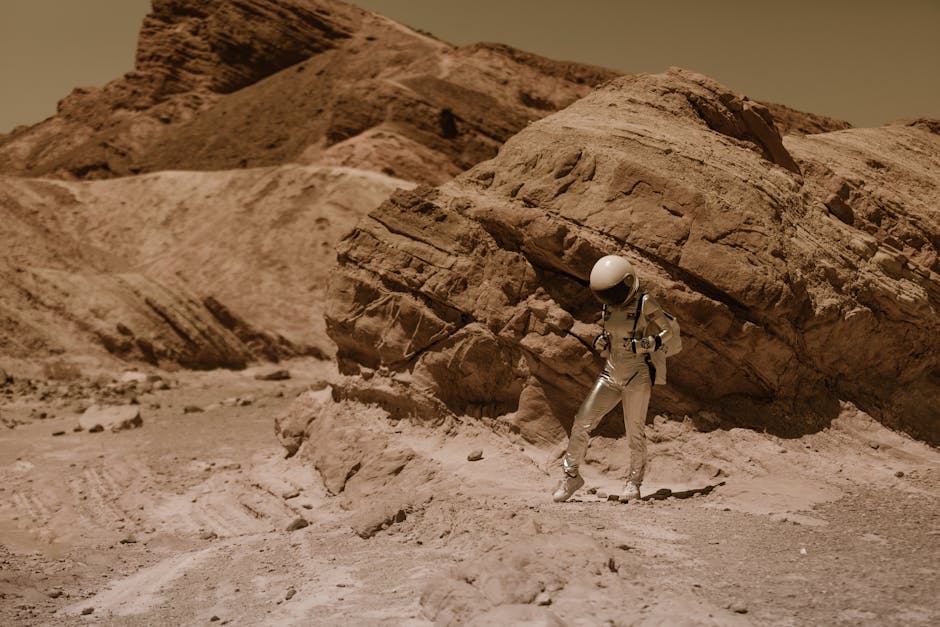
- Recent lab experiments show that certain microorganisms can survive harsh Martian conditions, including shock waves and toxic perchlorate salts.
- Yeastly, yeast cells were able to withstand simulated Martian shock waves and toxic perchlorate salts in a groundbreaking study.
- The discovery has significant implications for the search for life beyond Earth and raises questions about life on other planets with hostile environments.
- Mars is a hostile environment due to its thin atmosphere, extreme temperatures, and toxic soil, making it challenging for life as we know it to exist.
- Despite the challenges, scientists have long suspected that life may still be able to find a way to survive on Mars.
The possibility of life on Mars has long fascinated scientists and the general public alike. While the Red Planet’s harsh environment is often cited as a major obstacle to life, recent lab experiments have revealed that certain microorganisms can survive some of the most significant threats to life on Mars. In a groundbreaking study, yeast cells were subjected to simulated Martian shock waves and toxic perchlorate salts, and remarkably, they managed to survive. This finding has significant implications for the search for life beyond Earth and raises important questions about the potential for life to exist on other planets with hostile environments.
Mars: A Hostile Environment

Mars is often referred to as the most Earth-like planet in our solar system, but it is still a far cry from being a hospitable environment for life as we know it. The planet’s atmosphere is thin, the temperatures are extreme, and the soil is toxic. One of the major environmental threats on Mars is the presence of perchlorate salts, which are highly toxic to most living organisms. Additionally, the planet’s surface is regularly bombarded with shock waves caused by meteorite impacts, which can be devastating to any potential life forms. Despite these challenges, scientists have long suspected that life may still be able to find a way to survive on Mars.
Simulating Martian Conditions

In an effort to better understand how life might survive on Mars, scientists have been conducting lab experiments that simulate the Martian environment. In one such study, yeast cells were subjected to simulated Martian shock waves and toxic perchlorate salts. The results were surprising: the yeast cells were able to survive both the shock waves and the toxic salts. But how did they manage to do so? The answer lies in the cells’ ability to form protective molecular clusters that shield critical cellular functions under stress. These clusters, known as biomolecular condensates, allow the cells to protect their vital functions and survive even in the most hostile environments.
Understanding the Survival Mechanism
The discovery of the yeast cells’ survival mechanism has significant implications for our understanding of how life might survive on other planets. The formation of biomolecular condensates is a complex process that involves the clustering of specific molecules within the cell. These clusters act as a kind of protective shield, safeguarding the cell’s vital functions from the damaging effects of the environment. Without these defenses, the yeast cells were unable to survive the simulated Martian conditions, highlighting the critical importance of this survival mechanism. The fact that yeast cells are able to form these protective clusters suggests that this may be a universal strategy that life could use to survive in hostile environments beyond Earth.
Implications for the Search for Life
The finding that yeast cells can survive simulated Martian conditions has significant implications for the search for life beyond Earth. If life is able to survive on Mars, it is likely that it could also survive on other planets with similarly hostile environments. This raises the possibility that life may be more widespread in the universe than we currently think. The discovery of biomolecular condensates as a survival mechanism also highlights the importance of considering the complex interactions between living organisms and their environment when searching for life beyond Earth.
Expert Perspectives
Experts in the field of astrobiology are hailing the discovery as a major breakthrough. “This study shows that life can survive in environments that were previously thought to be inhospitable,” said one expert. “It’s a game-changer for the search for life beyond Earth.” Others, however, are more cautious, pointing out that the study was conducted in a lab and that the conditions on Mars are likely to be far more complex and challenging than those simulated in the experiment.
As scientists continue to explore the possibility of life on Mars and beyond, the discovery of biomolecular condensates as a survival mechanism raises important questions about the potential for life to exist on other planets. What other strategies might life use to survive in hostile environments? And how might we detect these survival mechanisms in our search for life beyond Earth? These are questions that scientists will be seeking to answer in the years to come, and the discovery of yeast cells’ ability to survive simulated Martian conditions is an exciting first step in this journey.