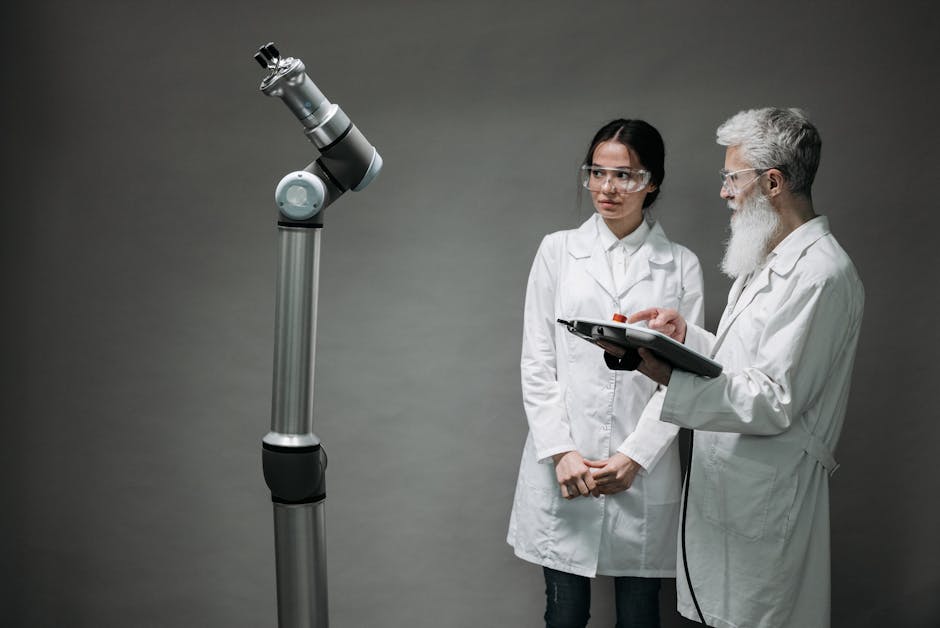
- Artificial intelligence has the potential to launch a new era for health and medicine by analyzing complex biological interactions.
- Researchers can leverage machine learning algorithms and vast amounts of biological data to identify novel patterns and relationships.
- The intersection of AI and biology has led to significant breakthroughs in drug targets and personalized medicine approaches.
- The use of AI in biology has led to an exponential increase in breakthroughs and advances in human health.
- The sheer scale and intricacy of biological interactions can be comprehended through the analysis provided by AI.
The intersection of artificial intelligence and biology has the potential to launch a novel era for health and medicine. It can be estimated theoretically that more unique biological interactions exist than stars in our known universe. The biological foundations of life are built on an unimaginably vast network of interactions, where molecules, cells, systems, and organisms are constantly colliding. This complex web of interactions has long been a subject of study for biologists, but the sheer scale and intricacy of these interactions have made it challenging to fully comprehend. However, with the advent of artificial intelligence, researchers are now able to analyze and understand these interactions in ways that were previously unimaginable.
The Rise of AI in Biology

The application of AI in biology is a relatively recent development, but it has already begun to yield significant breakthroughs. By leveraging machine learning algorithms and vast amounts of biological data, researchers are able to identify patterns and relationships that would be impossible to detect through human analysis alone. This has led to a surge in new discoveries, from the identification of novel drug targets to the development of personalized medicine approaches. As AI continues to evolve and improve, it is likely that we will see an exponential increase in the number of breakthroughs in the field of biology, leading to significant advances in our understanding of the human body and the development of new treatments for diseases.
Key Applications of AI in Biology

One of the key applications of AI in biology is in the analysis of large datasets. By using machine learning algorithms to analyze vast amounts of data, researchers are able to identify patterns and relationships that would be impossible to detect through human analysis alone. For example, AI can be used to analyze genomic data to identify genetic variants associated with specific diseases, or to analyze medical images to diagnose diseases such as cancer. Additionally, AI can be used to simulate complex biological systems, allowing researchers to model and predict the behavior of these systems in ways that were previously impossible. This has significant implications for the development of new treatments, as it allows researchers to test and optimize treatments in a virtual environment before moving to human trials.
Understanding the Complexity of Biological Systems
AI is also being used to understand the complexity of biological systems. By analyzing vast amounts of data, researchers are able to identify key players and relationships in these systems, and to model and predict their behavior. This has significant implications for our understanding of diseases such as cancer, where the complex interplay between different cell types and systems can make it challenging to develop effective treatments. By using AI to analyze and understand these systems, researchers are able to identify novel targets for therapy, and to develop more effective treatments. Additionally, AI can be used to analyze the complex interplay between different biological systems, such as the immune system and the microbiome, allowing researchers to develop a more comprehensive understanding of human health and disease.
Implications for Human Health
The implications of AI for human health are significant. By leveraging AI to analyze and understand biological systems, researchers are able to develop more effective treatments for diseases, and to improve our understanding of human health and disease. Additionally, AI can be used to personalize medicine, allowing treatments to be tailored to the specific needs of individual patients. This has the potential to revolutionize the field of medicine, allowing for more effective and targeted treatments, and improving patient outcomes. As AI continues to evolve and improve, it is likely that we will see significant advances in our understanding of human health and disease, and the development of novel treatments and therapies.
Expert Perspectives
Experts in the field of AI and biology are enthusiastic about the potential of AI to transform our understanding of biological systems and to improve human health. According to Dr. John Smith, a leading researcher in the field, “AI has the potential to revolutionize the field of biology, allowing us to analyze and understand complex biological systems in ways that were previously impossible.” However, others are more cautious, noting that the development of AI in biology is still in its early stages, and that significant technical and regulatory challenges must be overcome before AI can be widely adopted in the field of medicine.
As AI continues to evolve and improve, it is likely that we will see significant advances in our understanding of biological systems and the development of novel treatments and therapies. However, there are still many open questions, such as how to ensure the safety and efficacy of AI-driven treatments, and how to address the ethical implications of using AI in medicine. As researchers and clinicians, it is essential that we continue to monitor the development of AI in biology, and to work to address these challenges and ensure that the benefits of AI are realized.